Sanford Natural Area

The newest frame from every camera looked at each morning, sorted and shown as you choose; press one for its picture large, its days along the foot and a time lapse.

How the wall is ordered

Under Most colour now, the frames from the newest day and the day before come first, and among them the clearest and most coloured lead: each frame is read when the page is built, for how much of what the wall shows of it is in autumn reds, oranges and golds, how much fine detail fog, rain or a wet lens has left it, and how well it is lit. Older frames follow, newest first. The word under each frame sets the camera’s newest frame against its own earlier days this year, never against another camera’s: still green, turning, at its best, or past its best once its colour has clearly fallen, bare branches included. A river gauge’s frame is mostly water and bank, so it carries no word.

All cameras

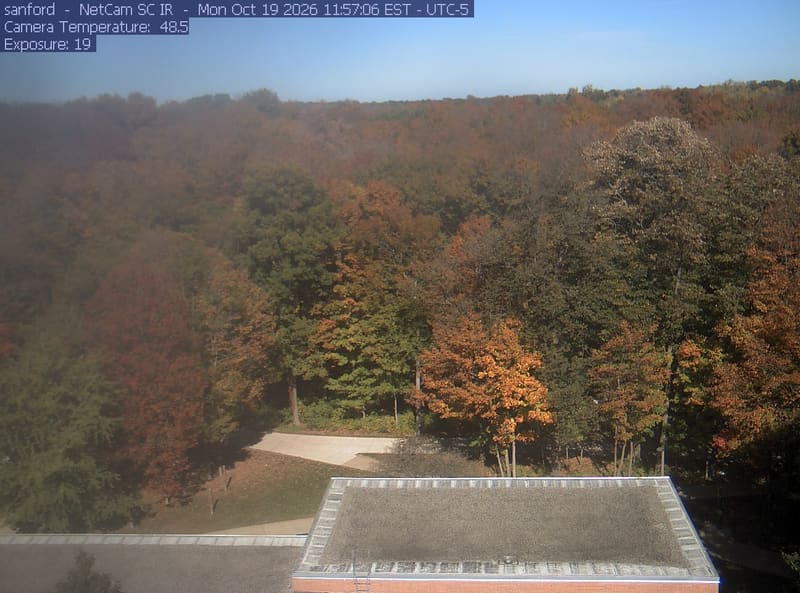
A broad stand of green, orange and red crowns fills most of the view above a foreground roof. A haze over the left half softens the crowns there, while those on the right stay sharp.

Sanford Natural AreaOctober 19, 2026 · 11:57 camera time

Michigan

Michigan

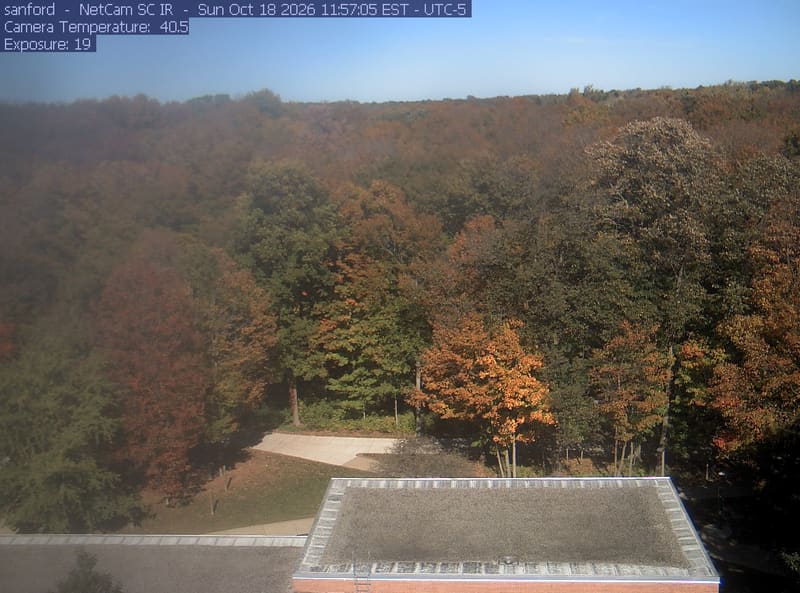
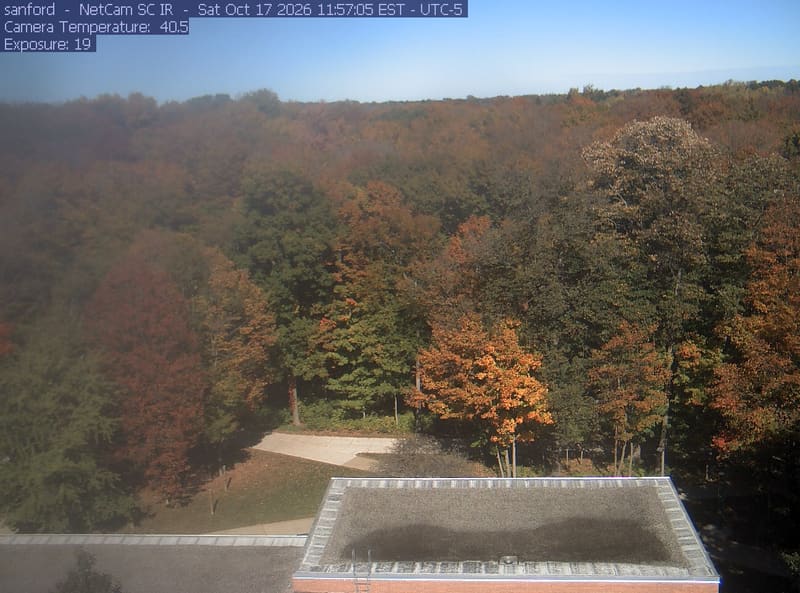
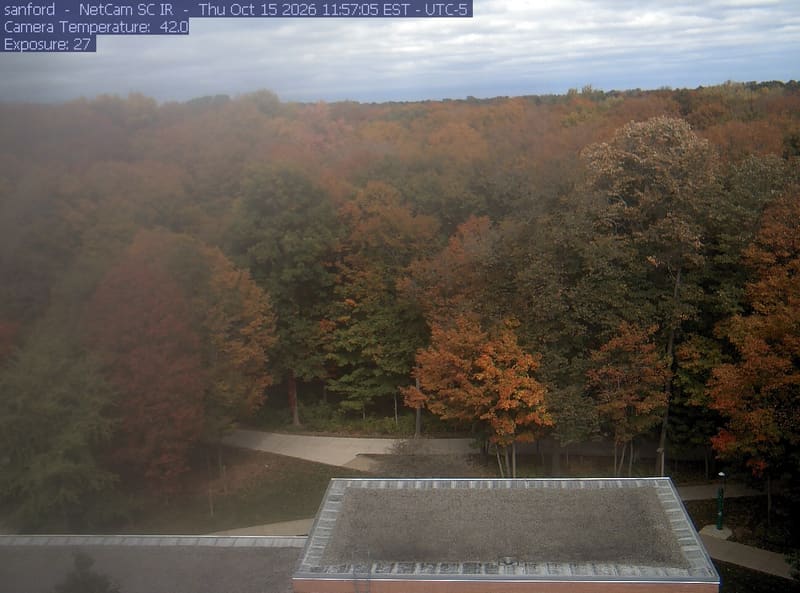
Turning · 4 days saved here this year, from October 15 to October 19, 2026

PhenoCam Network / Sanford Natural Area, Michigan State University, East Lansing, Michigan

Each small map’s outline: Natural Earth

Acknowledgments

The PhenoCam network asks us to say:

Data used in this research were provided by the PhenoCam Network, which has been supported by the Northeastern States Research Cooperative, the National Science Foundation, the Long-Term Agroecosystem Research (LTAR) network supported by the United States Department of Agriculture, the National Ecological Observatory Network (NEON) program sponsored by the National Science Foundation and operated under cooperative agreement by Battelle, the U.S. Department of Energy, Oak Ridge National Laboratory managed by UT-Battelle, the U.S. National Park Service Inventory and Monitoring Program, the USA National Phenology Network, and the North Central Climate Science Center of the United States Geological Survey.